
CHINAPLAS 2026: PHA Water-Coated Paper Cups as Mainstream Eco Solution
Shanghai, April 23, 2026 — The 38th International Exhibition on Plastics and Rubber Industries (CHINAPLAS 2026) is underway at the National Exhibition and Convention Center (Hongqiao) in Shanghai. Held from April 21 to 24, the event covers an exhibition area of over 390,000 square meters. As one of Asia’s largest exhibitions of its kind, it gathers more than 5,000 exhibitors worldwide and attracts nearly 300,000 professional visitors. Centered on circular economy, digitalization, innovative materials and advanced Chinese technology, the 2026 show delivers a clear signal to the global plastics and rubber industry: green and low-carbon development is no longer merely an exhibition slogan, but a practical factor influencing material selection, supply chain restructuring and market access.
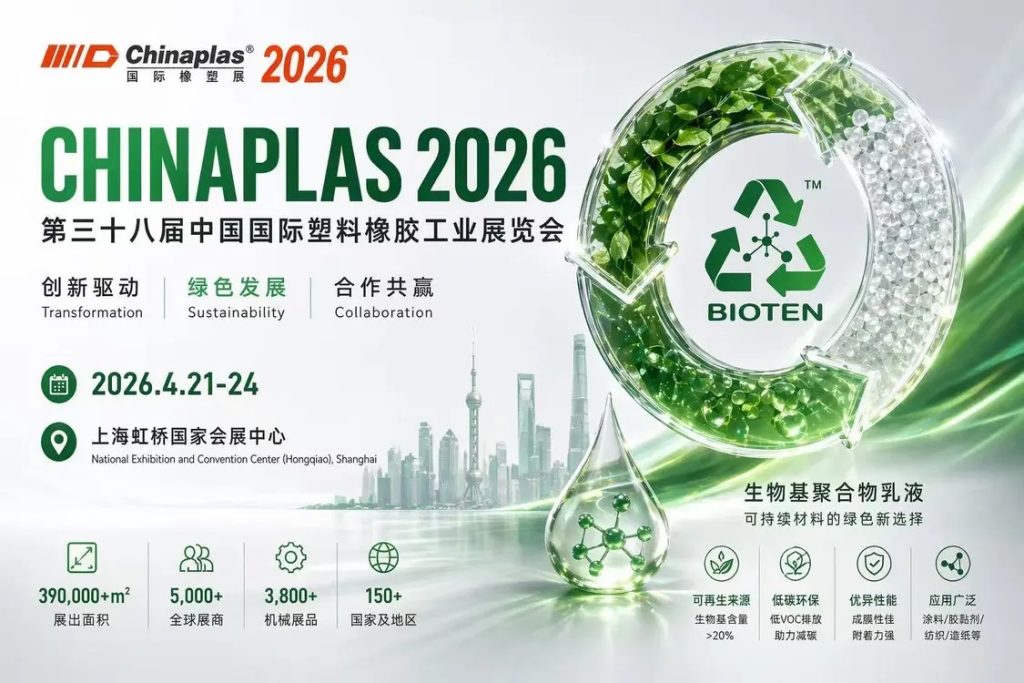
Against this backdrop, Bioten™ PHA bio-based polymer materials have become an important observation highlight at this year’s CHINAPLAS.
Market data from European Bioplastics shows that global production capacity of bio-based plastics is expected to rise from 2.31 million tonnes in 2025 to approximately 4.69 million tonnes by 2030. Packaging remains the largest application market, accounting for 41.3% of global bioplastics capacity in 2025. This means competition in bio-based materials has shifted from “trend narratives” to “application screening”: only materials that can enter real processing systems, real packaging scenarios and formal compliance frameworks are likely to secure market opportunities in the next stage.
PHA is one material being rediscovered during this round of screening. Under CHINAPLAS’s official “5 Popular Thematic Routes”, the PHABUILDER PHA Coating Solution at Booth 1.2D72 has been included in the popular themed tour. Official public information indicates the solution covers paper cups, coated packaging and pellet raw materials, and has been implemented in mass production. It boasts high-speed, stable processing performance, and has passed tests related to heat resistance, 95°C coffee leakage prevention and food contact compliance. Meanwhile, it features recyclability and home compostability. This explains why PHA attracts wide attention at the exhibition — interest lies not merely in its “bio-based” or “compostable” labels, but in its application pathways being recognized by the industrial sector.
The value of Bioten™ PHA under DUC Group should also be understood within this framework. Instead of simply displaying a type of bio-based plastic, it takes bio-based polymer emulsions as the core to connect PHA raw materials, water-based barrier coatings, finished paper-based end products and more water-based industrial scenarios. At the Zhongguancun Forum, Bioten defined this direction as “Bio-based Polymer Emulsions: From Industrial Collaboration to Engineering Implementation and Disruptive Applications Across Multiple Fields”. Its underlying logic is not a single product, but “one platform covering diverse scenarios”.
Paper-based food packaging is Bioten™ PHA’s clearest industrial entry point. For a long time, food packaging such as paper cups, paper bowls and paper bags mainly relies on extrusion/lamination routes including PE coating to achieve water resistance, oil resistance, heat sealing and formability. While the PE coating route is mature, stable with a clear cost system, its paper-plastic composite structure makes it difficult for high-value paper fibers to re-enter high-quality recycling systems. As accurately summarized at the Bio-Manufacturing New Materials Industry Innovation Conference of the Zhongguancun Forum: PE coating “solves the usability problem, yet fails to address the circularity problem.”
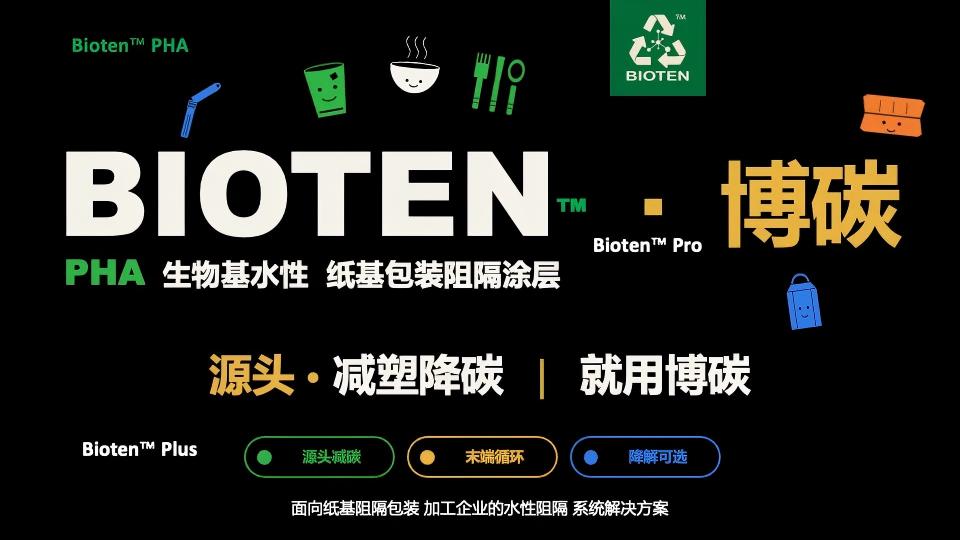
Therefore, the real challenge of paper substituting plastic lies not in “degradability”, but in whether a complete material system can be established. Any material eligible for food packaging must address four sets of issues simultaneously: regulatory compliance, functional performance data, applicable scenarios, recycling and degradation. The technical dimensions covered by Bioten™ PHA barrier technology include water resistance, oil resistance, moisture resistance, oxygen resistance, heat-sealing temperature, heat-seal strength, medium-to-high-speed coating, medium-to-high-speed cup forming, food contact regulations, post-recycling and compost degradation. In other words, replacing plastic with paper is not a single-material problem, but a systematic project spanning materials, processes, equipment, regulations and end-of-life disposal.
This is the core reason why Bioten™ PHA is hailed as a “dark horse”. The so-called dark horse is not an overnight concept; instead, it advances PHA from “material possibility” to “engineering pathway”. According to relevant presentation materials, Bioten™ PHA has formed three capability tiers: Bioten™ Plus, Bioten™ Pro and Bioten™ Ultra, covering different barrier grades, varying bio-based content, diverse post-recycling rates and different compost degradation speeds. It delivers differentiated solutions for paper-based packaging such as food cardstock, thin paper, kraft paper, bamboo pulp paper and paper pulp molding.
More importantly, Bioten™ PHA’s industrialization path does not remain confined to laboratory research. Industry experts commented at the international plastics and rubber exhibition that from 2022 to 2025, continuous progress has been made in technical breakthroughs, industrial chain collaboration, full-industry-chain application of lightweight paper cups, recyclability of paper cups coated with water-based coatings, and the Zero-Carbon Circular Paper Cup Alliance. Up to the launch of mass production equipment for water-based barrier coating technology in February 2025, Bioten™ PHA-related solutions have gradually moved from material verification to industrial collaboration and engineering implementation. This progress demonstrates that Bioten™ PHA aims to resolve not whether the material can be manufactured, but whether it can be integrated into real industrial systems including papermaking, coating, product fabrication and brand procurement.
Evolving regulatory frameworks are also elevating the value of such systematic solutions. The EU Packaging and Packaging Waste Regulation (PPWR) entered into force on 11 February 2025 and will be generally applicable from 12 August 2026. It covers all packaging and packaging waste and sets requirements for packaging manufacturing, composition, reusability and recyclability. Meanwhile, the US FDA has confirmed that 35 food contact notifications related to PFAS will no longer be valid starting from 6 January 2025. These notifications previously covered oil-resistant coatings for paper and paperboard food packaging. Competition among food packaging materials is shifting from rivalry over single barrier indicators to comprehensive competition covering material properties, chemical management, market access, recycling coordination and end disposal pathways.
Nevertheless, viewing Bioten™ PHA merely as a paper-based barrier coating underestimates its technical extension. What truly deserves attention is the interface of PHA emulsification. When PHA transitions from the logic of pellets, resins and conventional plastic products into water-based polymer emulsion systems, it gains access to a broader range of industrial scenarios. According to presentations shared at the Zhongguancun Forum, Bioten™ PHA’s platform layout extends to four major sectors: construction & industrial coatings, agricultural systems, personal care & daily chemicals, and adhesives & packaging coatings. The portfolio includes architectural coatings, industrial coatings, marine coatings, seed coating agents, slow-release fertilizer encapsulation films, agricultural mulch films, shower gels, facial cleansers, hair care products, bio-based adhesives, paper-based barrier coatings and special dispersants.
This platform logic carries particular weight at comprehensive international expos such as CHINAPLAS. CHINAPLAS is not merely a packaging exhibition; it serves as an integrated industrial platform covering plastics, rubber, chemical raw materials, processing machinery, packaging, automotive, electronics, personal care, medical applications and advanced new materials. If Bioten™ PHA only focuses on paper cups, it will only attract audiences interested in paper-for-plastic replacement. By further elaborating its positioning as a “bio-based polymer emulsion platform”, it can capture greater attention spanning bio-based plastics, innovative materials, water-based coatings, functional packaging, agricultural materials and daily chemical alternatives.
Market data supports this extended layout. Application statistics released by Bioten™ PHA show that the construction and industrial coatings market exceeded 1.4 trillion RMB in 2025; the global personal care and washing market surpassed 1.78 trillion RMB; the global market for special agricultural polymers and coating materials exceeded 137.6 billion RMB; and the global adhesives and packaging coatings market exceeded 551.2 billion RMB. These figures collectively point to one conclusion: after PHA emulsification, the technology targets not a single-product market, but a series of industrial sectors seeking low-carbon, bio-based and sustainable alternatives.
Of course, platformization does not mean equal investment across all directions. For Bioten™ PHA, the primary track that has achieved the fastest and deepest commercial penetration remains water-based barrier coatings for paper-based food packaging. This scenario simultaneously faces policy pressure, sufficient market scale, clear customer demand and verified engineering solutions, making it the most realistic breakthrough for PHA to evolve from material concept to industrial application. Multi-scenario deployment represents the medium- and long-term expansion potential of Bioten™ PHA as a platform-type bio-based waterborne material.
Therefore, Bioten™ PHA at CHINAPLAS 2026 stands as a signal: bio-based materials are shifting from “additive innovation” toward “structural substitution”, and PHA is moving from discussions limited to “degradable materials” to the industrial concept of a “water-based material platform”. Its value lies not only in being bio-based or compostable, nor simply paper-for-plastic substitution. Instead, it attempts to integrate materials, processes, finished goods, regulations and market adoption within a unified industrial framework.
Against the backdrop of accelerating decarbonization, stricter compliance and scenario-oriented development across the global plastics and rubber industry, truly valuable new materials are not those with the loudest promotion, but those earliest adopted by industrial systems, validated by client supply chains and accepted by regulatory regimes. For Bioten™ PHA, paper-based barrier coating serves as the entry point, bio-based polymer emulsion acts as the technical interface, and multi-sector application forms the expansion frontier. This explains why it deserves to be called a “dark horse among new bio-based materials” at CHINAPLAS 2026.
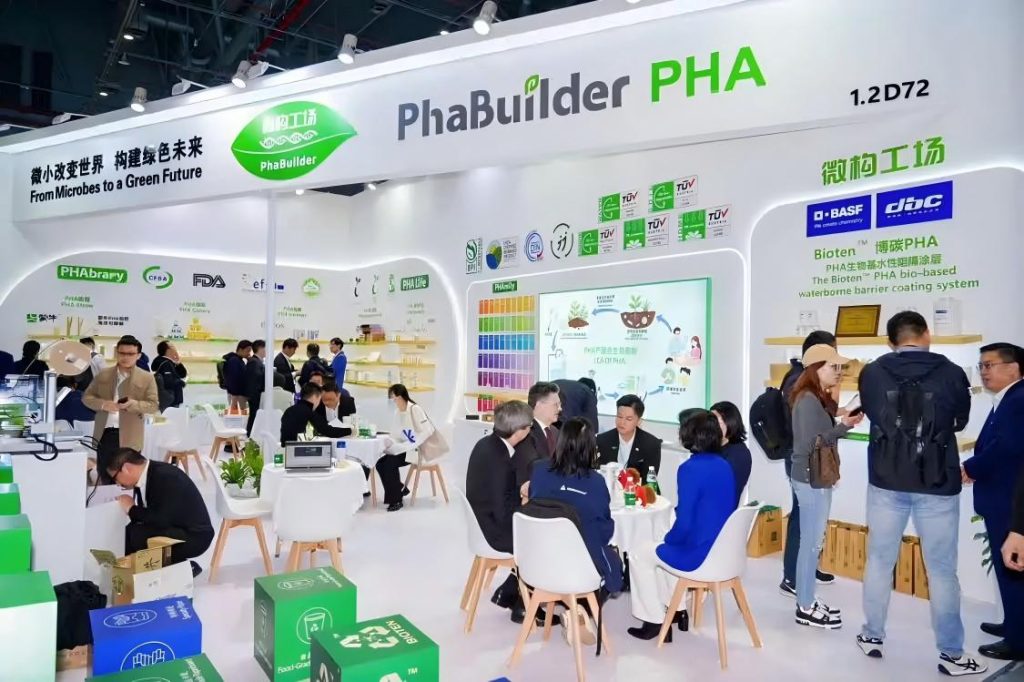
During the exhibition, the Bioten™ PHA team maintained an open booth at Booth 1.2D72 for technical exchanges and cooperation matchmaking. The team communicated with upstream and downstream partners across the industrial chain covering multiple application directions including water-based barrier emulsions, coated paper, finished paper-based products, as well as architectural coatings, industrial coatings, agricultural encapsulation, personal care & daily chemicals, and adhesives. For enterprises seeking upgrade routes for bio-based materials, Bioten™ PHA stands out not merely as a paper-for-plastic solution, but as an engineering pathway extending from paper-based barrier technology to a multi-sector water-based material platform.
About Bioten™ PHA
Bioten™ PHA is a bio-based polymer emulsion and water-based barrier technology solution developed by DUC Group for paper-based food packaging and multi-scenario waterborne material applications. The system features systematic development covering PHA raw materials, water-based dispersion, coating engineering and end-product applications. It focuses on the core track of barrier solutions for paper-based food packaging, while exploring extended applications in coatings, adhesives, agricultural encapsulation, personal care & daily chemicals and functional water-based materials. It drives bio-based materials forward from “conceptual substitution” to “engineering implementation”
.